
Most drivers know the feeling of that sudden loss of power, the steering going heavy, or the warning light that flicks on at the worst possible moment. On a quiet suburban street, a breakdown is stressful. On the Gateway Motorway at peak hour, or on the M1 heading toward the Gold Coast at 110 km/h, it becomes something else entirely. The first 60 seconds after your car stops working on a Brisbane highway are the most important — and most drivers have never actually thought about what to do until it happens to them.
Here is exactly what to do, in order, so you get through it safely.
The First 60 Seconds — Move Left Immediately
The moment you feel something is wrong then engine losing power, tyre blowing, warning light followed by smoke then do not brake suddenly and do not panic. Signal left immediately and begin moving toward the left shoulder or emergency lane as calmly and smoothly as possible. Use whatever momentum the car still has. Every metre you can get off the main carriageway reduces your risk significantly.
On Brisbane's major motorways are the Gateway Motorway, Pacific Motorway, Logan Motorway, and Ipswich Motorway — traffic moves fast and drivers have very little reaction time. Getting your vehicle onto the emergency stopping lane is the single most important thing you can do in those first seconds. If you can see an emergency stopping bay ahead, aim for it. These are purpose-built for exactly this situation and give you far more protection than a narrow shoulder.
Once stopped, apply your handbrake, switch off the ignition, and turn on your hazard lights immediately. Do not wait until you are fully stopped to hit the hazards — turn them on the moment you start moving left so vehicles behind you have maximum warning.
Stay Inside the Car — Queensland Roads Have a Specific Rule
This is the part most Brisbane drivers get wrong. The instinct is to get out, open the bonnet, and have a look. On a highway, this instinct can get you killed.
Queensland's Department of Transport and Main Roads is clear on this: on any road where traffic is travelling faster than 80 km/h, you should stay inside your vehicle with your seatbelt fastened. Your car — even a broken-down one — offers significantly more protection than standing on the shoulder next to vehicles passing at highway speed. On the Gateway Motorway, the Pacific Motorway, or anywhere along the M1 corridor, stay in the car, keep your seatbelt on, and wait for professional help.
The only exceptions are if the vehicle is on fire, if there is a fuel leak, or if staying inside creates an immediate danger. In those cases, exit from the passenger side away from traffic and move well behind the barrier or up the embankment — never stand behind the car or on the road shoulder where traffic is moving.
If it is safe to exit — on a quiet road well clear of traffic — and you have a warning triangle, place it at least 45 metres behind the vehicle. If you have a high-visibility vest in the boot, put it on before stepping out.
Exactly Who to Call and In What Order
Once you are safe, the calls you make in the next few minutes determine how quickly the situation gets resolved. Here is the correct order for Brisbane highway breakdowns.
If there is any immediate danger to life — call 000 first. This covers injury, fire, or a situation where someone is at serious risk. Do not call anyone else until emergency services are on the way.
If you have broken down on a monitored Queensland motorway — call QLD Traffic on 13 19 40. This covers the Gateway Motorway, Logan Motorway, Ipswich Motorway, and the Pacific Motorway. QLD Traffic monitors these roads via CCTV and can dispatch motorway incident response vehicles to assist. In some cases, they can arrange a free courtesy tow to move you off the motorway to a nearby safe location. If you are on a Linkt-managed toll road section, you can also call Linkt on 13 33 31.
If you are an RACQ member — call 13 11 11. Your membership covers roadside assistance and potentially a tow to the nearest repairer. Check your membership level because not all plans include towing beyond a set distance.
If you are not an RACQ member or your car needs towing beyond what RACQ covers — call a professional tow truck service directly. Brisbane Towing Service operates 24/7 across all Brisbane motorways and surrounding areas. One call to 0466 890 373 gets you a real person, an upfront quote, and a truck dispatched within minutes.
What to Tell the Tow Truck Operator
When you call for emergency towing Brisbane highway assistance, the operator needs specific information to reach you quickly. Have these details ready before you call:
Your exact location matters more than anything else. On motorways, look for the green kilometre markers on the side of the road — these give the operator your precise position far more accurately than a suburb name. If you cannot find a marker, use your phone's GPS to get coordinates, or describe the nearest interchange or overpass. "On the Gateway Motorway southbound, just past the Nudgee Road interchange" is far more useful than "somewhere near Nudgee."
Also tell the operator your vehicle type, what happened, and whether the car can roll freely or has been in an accident and cannot move. This determines which truck gets dispatched and whether specialist recovery equipment is needed. Telling them upfront saves time and avoids the wrong truck arriving.
Night Breakdowns and Brisbane's Storm Season
A highway breakdown becomes more dangerous in low light, heavy rain, or during one of Brisbane's afternoon storms. If you break down at night or in poor weather on the Gateway Bridge approach, along the M1 through Eight Mile Plains, or anywhere on the Ipswich Motorway during a downpour — visibility for other drivers drops significantly.
Keep your hazard lights running continuously. If you have any additional visibility tools — a torch, a reflective triangle, a vest — use them. Do not rely on other drivers to spot you. Stay low in the vehicle and away from the windows facing oncoming traffic if the weather is severe.
Call for help immediately rather than waiting to see if the car will restart. In a storm on a Brisbane motorway, waiting is the most dangerous option. A breakdown towing Brisbane team that knows the local roads and motorway access points will reach you faster than one navigating unfamiliar territory — which is why using a locally based operator matters in these situations.
After the Truck Arrives — What Happens Next
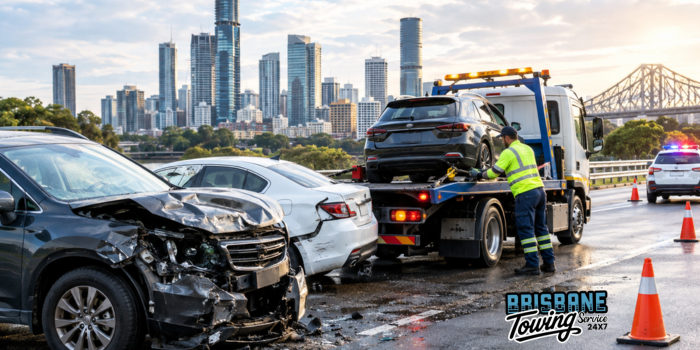
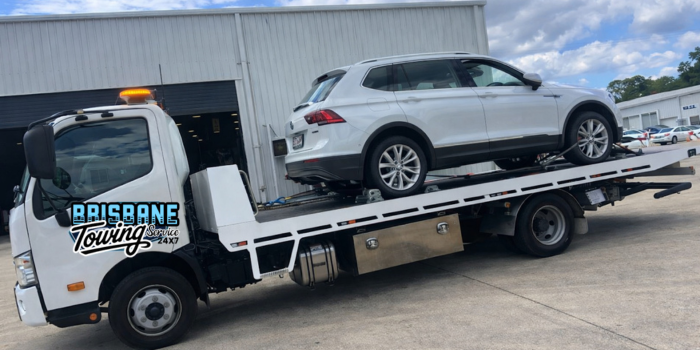
When the tow truck arrives, the driver will assess the vehicle, confirm your destination, and load the car onto the flatbed. You will typically be able to ride in the cab to your destination. Confirm the drop-off address before the vehicle is loaded — once it is on the truck, changing the destination may affect pricing.
For Brisbane highway breakdowns, common drop-off points include the nearest mechanic open at the time, your home address, or a storage yard if the breakdown happens late at night and no workshop is open. Brisbane Towing Service can advise on nearby repairers if you are unfamiliar with the area.
If the breakdown is the result of an accident or a mechanical failure covered by your comprehensive insurance policy, note down the tow truck operator's details, the pickup location, and the drop-off address. This information is needed for the insurance claim. A professional operator like Brisbane Towing Service can also handle direct insurance billing, removing the paperwork from your hands at the worst possible moment.
One Number to Save Before You Need It
The best time to find a reliable tow truck is before you ever need one. Save a trusted number in your phone now so that when you are sitting on the Gateway Motorway shoulder at 11 PM with your hazards on, the decision is already made.
Brisbane Towing Service responds to highway breakdowns across the Gateway Motorway, Pacific Motorway, Logan Motorway, Ipswich Motorway, and all surrounding Brisbane roads — 24 hours a day, every day of the year. Tows start from $99, quotes are given upfront over the phone before anyone is dispatched, and direct insurance billing is available for accident-related jobs.