
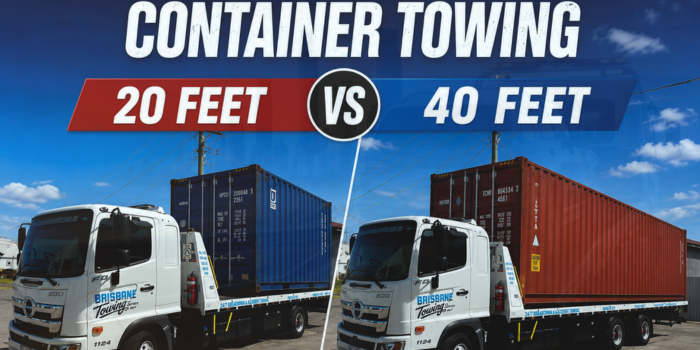
Most people booking container transport in Brisbane focus on two things — the container size and the price. What they do not always think about is what truck and equipment are actually required to move the container safely, and how dramatically that changes between a 20ft and a 40ft unit.
Get it wrong and the truck that shows up cannot complete the job. The container sits where it is. The delivery window is missed. And the cost of a second callout with the right equipment is added to a bill that was already bigger than expected.
This is what every Brisbane homeowner, business owner, and site manager needs to understand before booking container transport — and why choosing a cheap tow truck in Brisbane that actually has the right equipment matters more than the headline price.
What Makes a 20ft and 40ft Container Different
Before the truck requirements, the container specs.
A standard 20ft shipping container is 6.06 metres long, 2.44 metres wide, and 2.59 metres high externally. Empty, it weighs approximately 2,200 kilograms. Fully loaded, it can weigh up to 28,000 kilograms depending on contents — though most domestic and light commercial loads sit considerably below this maximum.
A standard 40ft shipping container is 12.19 metres long, the same 2.44 metres wide, and 2.59 metres high. Empty weight is approximately 3,800 kilograms. Maximum payload capacity is around 26,500 kilograms, giving a maximum gross weight approaching 30,000 kilograms for a fully loaded unit.
High cube variants of both sizes add an extra 30 centimetres of height — external height becomes 2.89 metres. This single difference changes the clearance requirements on the transport route and is one of the most common details that gets missed when booking container transport in Brisbane.
20ft Container Transport | What Truck and Equipment You Need
A 20ft container transport job in Brisbane is the more flexible of the two. The shorter length, lighter empty weight, and manageable footprint give transport operators more equipment options.
Tilt Tray Truck
The most common equipment for 20ft container transport in Brisbane is a tilt tray truck — the same flatbed tilt tray used for vehicle towing, configured and rated for container loads. The deck tilts down to close to ground level, the container is winched or rolled onto the deck, and the tray returns to the transport position.
For empty or lightly loaded 20ft containers on standard residential or commercial sites with reasonable access, a tilt tray is often the most cost-effective and practical option. It does not require crane access, can manoeuvre into tighter sites than a skel trailer, and can be positioned quickly.
The limitation is site conditions. A tilt tray requires relatively flat ground to load and unload safely. A sloping driveway, a soft surface, or a site where the tray cannot reach the ground at a safe angle all change the equipment requirements.
Skel Trailer
For 20ft containers being moved from the Port of Brisbane or between commercial facilities, a skel trailer — a skeletal trailer with container locking pins — is the standard equipment. The container is craned or side-loaded onto the trailer at origin and craned or side-loaded off at destination. This is the equipment used for wharf cartage.
The skel trailer requires crane access at both ends of the journey, which adds to the overall job cost but is standard practice for port collections.
Side Loader
A side loader truck carries its own hydraulic lifting arms that slide under the container and lift it for transport. Side loaders are efficient for sites where crane access is not available, and can place containers with reasonable precision. For 20ft container transport, they are particularly effective at residential and rural property deliveries where a flat placement area is available.
40ft Container Transport | What Changes and Why It Matters
A 40ft container transport job is a fundamentally different operation from a 20ft job. The length alone changes almost every aspect of the truck and equipment requirements.
The Length Problem
At 12.19 metres, a 40ft container is just over twice the length of a 20ft unit. On a transport vehicle, this creates a total combination length that moves the job into a different category for route planning, access assessment, and in some cases permit requirements.
Turning radius increases significantly. A site that a 20ft container on a tilt tray can access may not be accessible for a 40ft container on a B-double or semi-trailer combination. This is one of the most common surprises on 40ft container delivery day — the truck arrives and cannot get into the site.
Always confirm the total combination length before booking 40ft container transport. Then measure the access — the driveway entry, any turns on site, the placement area — against that length.
B-Double and Semi-Trailer
The standard road transport equipment for a 40ft container is a B-double or semi-trailer configuration with container locking pins. These combinations are longer, have larger turning radii, and require more clearance than the tilt tray equipment typically used for 20ft units.
For urban Brisbane deliveries — industrial estates in Rocklea, Eagle Farm, Acacia Ridge, or Yatala — these combinations navigate well on the main access roads but can struggle on tighter secondary streets and residential driveways. A site assessment before dispatch is standard practice for professional 40ft container transport operators.
Weight Considerations
A loaded 40ft container can weigh significantly more than a loaded 20ft unit simply because the capacity is larger. For heavy loads — industrial equipment, dense stock, construction materials — the total gross mass of the container and transport vehicle can approach or exceed standard road limits.
When the combined weight exceeds axle load limits for the route, either the container needs to be partially unloaded before transport, the route needs to be changed to roads with higher load ratings, or a permit needs to be obtained for an oversize or overmass load.
This is not a detail that should be discovered at the weighbridge. A professional operator asks about the container contents and estimated weight before dispatch — not after the truck is already loaded.
Permit Requirements in Queensland
Standard empty or lightly loaded containers within normal road dimensions generally do not require special permits for Queensland road transport. The combination vehicle itself holds the relevant road access permits as part of its registration.
Where permits become necessary:
A 40ft high cube container at 2.89 metres height, combined with the transport vehicle height, can approach or exceed standard overhead clearance restrictions on some Queensland routes. Permit requirements depend on the specific combination height and the specific route.
An overweight loaded container may require an oversize or overmass permit depending on total gross mass and axle load distribution. Queensland's Department of Transport and Main Roads administers these permits — processing times vary depending on complexity.
A professional container transport operator identifies permit requirements before the job begins — not on the day. If an operator quotes a 40ft loaded container job without asking about weight or route details, that is worth questioning before confirming.
Don’t forget to check out these resources:
Machinery Lashing And Blocking Explained For Safe Transport In Brisbane
Caravan Towing Laws In Queensland 2026 Update
How Professional Motorcycle Towing Protects Your Bike
How Professional Boat Towing Protects Your Boat During Transport
Towing A Caravan In Brisbane: Essential Safety Tips For Every Driver
Site Conditions
This is the area that causes the most delays and additional costs on container transport jobs across Brisbane — and it is almost entirely within the client's control.
Access clearance
Measure the entry to the site — width, height clearance from any overhead structures, and whether the entry can accommodate the full combination length. For a 20ft container on a tilt tray, this is a relatively forgiving assessment. For a 40ft container on a semi-trailer, the margins are much tighter.
Ground condition at the placement area
Soft ground under the placement area compresses when a loaded container is set down on it. A site that looks solid can surprise you. Any area that has been recently disturbed, has clay-based soil, or drains poorly after rain needs to be assessed before a container is placed on it.
Overhead clearance along the approach
Trees, powerlines, building eaves, and any other overhead obstruction along the approach to the placement area need to be checked against the loaded height of the container on the transport vehicle. This applies particularly to high cube containers, which add that extra 30 centimetres that makes the difference between clearance and contact.
Turning room
From the entry to the placement area, the transport vehicle needs to be able to manoeuvre. For tilt tray deliveries of 20ft containers, this is often straightforward. For semi-trailer combinations delivering 40ft containers, the required turning room can surprise clients who have not thought about it in advance.
What We See Most Often on Brisbane Container Jobs
We have completed container towing jobs across Brisbane and Southeast Queensland — residential deliveries, industrial site moves, port collections from Port of Brisbane at Fisherman Islands, and inter-site relocations across the Brisbane metropolitan area.
The most consistent pattern we see is the site access problem that was not identified before dispatch. A client who assumed a 40ft container could be delivered down a standard residential driveway. A site with soft ground that was not visible in photos. An overhead powerline that was not considered when the placement area was chosen.
Every one of these situations is avoidable with a site visit or a detailed conversation before the truck is dispatched. The operators who do this consistently deliver containers without incident. The ones who skip it create avoidable problems on delivery day.
Brisbane Towing Service 24/7 for Container Transport
Whether you need 20ft container transport for a residential delivery or 40ft container transport for a commercial or industrial job, Brisbane Towing Service 24/7 handles container towing across Brisbane and Southeast Queensland with the right equipment for each specific job. Contact us now at 0466890373.