
You've finished the dig. The site's signed off. Now the excavator needs to be somewhere else by Monday morning. Book a low loader, strap it down, and drive it over. Sounds simple, until you realise that excavator transport in Brisbane involves weight classes, permits, and load restraint rules that catch experienced operators out regularly.
The part nobody mentions until it's too late: it's not the driving that creates problems. It's everything that needs to happen before the truck leaves the yard.
Here's the full picture.
Why Excavators Are Not Just Another Heavy Load
Excavators are awkward. Not just heavy unevenly heavy. The counterweight sits at the rear, the boom extends at an angle, and the tracks are almost always wider than they look on paper. None of that behaves like a container or a stack of steel sections.
A 12-tonne machine with a high centre of gravity and an extended boom can be significantly trickier to transport safely than a 20-tonne load that sits flat and balanced. This is exactly why excavator towing in Brisbane carries its own set of rules because the risks of getting it wrong are not theoretical.
The weight class of the machine and the dimensions it presents when sitting on a trailer determine everything that follows, what truck is needed, whether a permit is required, whether escort vehicles need to accompany the move, and which roads the combination can legally travel.
Explore These Helpful resources also:
Mining Equipment Towing In Brisbane
8 Things Brisbane Drivers Must Know About 24 Hour Tow Truck Services
What Every Brisbane Driver Must Do Immediately After A Highway Breakdown
Brisbane Drivers Are Ignoring Vehicle Warning Signs | And Paying For It Later
The Right Way To Move Any Shipping Container Safely
Weight Classes | What Actually Matters
Excavator transport decisions start with one number: the machine's actual transport weight — not its operating weight, since fuel, hydraulic fluid, and attachments all shift the figure.
In broad terms, Brisbane's excavator transport jobs fall into three categories:
Mini and compact excavators under 5 tonnes often fall within general access vehicle limits when sitting on an appropriate trailer. These machines can frequently be moved without a special permit — though load restraint requirements apply regardless, and the trailer rating must accommodate the combined weight of the machine and the trailer itself.
Mid-size excavators in the 5 to 20 tonne range are where most permit requirements kick in. Once the machine goes onto a low loader and the combination is assessed for total weight and width, these machines frequently cross into excess mass or excess dimension territory, pushing the job into permit territory even when operators assume they are under the threshold.
Large excavators above 20 tonnes almost always require a full Class 1 heavy vehicle permit and are typically classified as an indivisible load, meaning the machine cannot be broken down for transport, which places it into a specific regulatory category under Queensland's Heavy Vehicle National Law.
The most common mistake: adding the machine's weight and the trailer's rated capacity and assuming the combination is legal. The correct calculation adds the excavator's transport weight to the trailer's tare weight, then checks the total against both the trailer's Aggregate Trailer Mass and the tow vehicle's rated towing capacity.
Queensland Permits
In Queensland, heavy vehicles with a GVM over 4.5 tonnes operate under the Heavy Vehicle National Law. Vehicles that exceed standard mass and dimension limits require either a Heavy Vehicle National Law exemption notice — a pre-approved set of conditions — or a specific access permit applied for through the NHVR Portal.
The dimension thresholds that trigger permit requirements in Queensland:
Width over 2.5 metres: Most mid-size excavators on a standard low loader exceed this once track width is factored in. Beyond 3.1 metres, escort pilot vehicles become mandatory. Beyond certain thresholds, night travel restrictions apply.
Height over 4.3 metres: Its relevant when an excavator's boom or counterweight adds height to the load profile. Brisbane's road network includes overhead infrastructure that makes route planning essential for high-profile loads.
Length over 19 metres: It applies to the total combination length, not just the trailer. Long low loaders with extended excavators regularly approach or exceed this.
Queensland also applies curfew restrictions on oversized loads — major CBD areas including Brisbane City Council and Gold Coast City Council are generally off-limits during peak hours for oversize combinations. A neatly planned morning delivery can become an after-hours run as soon as the dimensions are properly assessed.
For Special Purpose Vehicles exceeding regulation mass in Queensland, a supervised weigh and measure is required before obtaining access to the state-controlled road network — adding a step that needs to be planned for, not discovered on the day.
Permits are not something to sort out the week before the job. Special Access Permit applications through the NHVR can take real processing time rushing this step is one of the most consistent ways that well-organised transport jobs stall at the worst moment.
Trailer Selection |Getting the Right Equipment for the Machine
Trailer selection depends on machine size and weight: flatbed trailers suit compact models, low loader trailers keep mid-size excavators below height limits and often reduce the permit category, and multi-axle configurations handle larger machines.
The trailer choice has direct permit implications. A low loader that reduces the overall combination height may keep a load within a lighter permit category avoiding the complexity and cost of a heavier classification. A standard trailer that puts the same excavator at a taller height profile can push the same job into a more restrictive category unnecessarily.
The right trailer for excavator towing in Brisbane is the one that fits the specific machine, keeps the load within the most manageable regulatory category, and is rated correctly for the combined weight. This is confirmed during the booking call, not discovered on site when the truck arrives.
Load Restraint
Queensland's Chain of Responsibility provisions extend beyond the driver. Everyone involved in arranging the transport of a heavy machine carries legal obligations related to load restraint compliance.
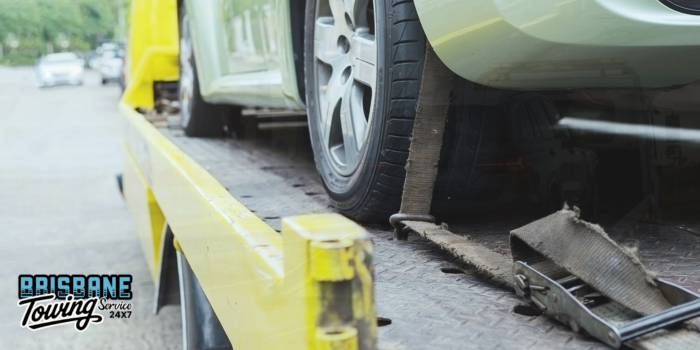
Mining and construction machinery often has moving parts, hydraulic arms, and loose attachments that need to be locked down before transport. Rated chains and tie-downs matched to the machine's actual weight class are not optional — improper load restraint is one of the leading causes of transport incidents involving heavy equipment.
For excavators specifically: the boom needs to be locked or secured to prevent uncontrolled movement during transit. The bucket or any attachment needs to be pinned and secured. Hydraulic systems need to be isolated where practical. Four-point rated chain restraint minimum — two at the front of the machine, two at the rear — with chain ratings that match or exceed the machine's transport weight.
A professional operator confirms the restraint method for the specific machine during the booking call. One that is vague about how the excavator will be secured is creating compliance exposure for every party in the chain.
Route Planning Around Brisbane's Real Restrictions
Route planning for excavator transport needs to account for low bridges, narrow roads, weight-restricted sections, and unsealed approaches to construction sites. Skipping this step can mean forced backtracking with an oversized load — far more costly than planning properly from the start.
Brisbane's road network has specific constraints that affect excavator transport routes:
The Gateway Motorway and Logan Motorway corridors are generally well-suited to heavy combinations but carry peak-hour restrictions for oversize loads. The inner-city network has overhead infrastructure and road geometry that limits oversize access at specific points. The industrial precincts at Acacia Ridge, Richlands, Eagle Farm, and Pinkenba are well-suited to heavy vehicle movements but each has access specifics that affect approach and positioning.
For regional Queensland runs — job sites in the Ipswich corridor, the Sunshine Coast hinterland, or further north — road conditions and bridge weight limits change significantly once the route leaves the standard heavy vehicle corridors. Local knowledge of where those constraints sit is what separates a smooth run from an unplanned delay.
How Brisbane Towing Service Handles Excavator Towing
The booking call for excavator towing in Brisbane starts with the machine — make, model, transport weight, dimensions, and what condition it is in. That information determines the trailer, the permit requirement, and the route before any truck moves.
Upfront pricing is confirmed on the call, based on the specific machine and the specific pickup and delivery locations. The price confirmed is the price on the invoice.
The driver arrives knowing what the job involves. Load restraint is applied with rated equipment matched to the machine's weight class. Permit requirements are confirmed before dispatch — not discovered on site. Route planning accounts for the combination's dimensions and the relevant access restrictions.
For tow trucks in Brisbane that handle excavator transport properly — from compact machines to mid-size excavators across Brisbane's construction and industrial corridors, Brisbane Towing Service is available 24/7.