
In this blog, Brisbane Towing Service, which is a trusted towing company provider of truck towing in Brisbane — has put together a complete guide on the emergency tools every Australian driver should carry at all times. Whether you are a daily commuter or a weekend road tripper, being prepared can make all the difference when things go wrong on the road. Let's get started!
Tools Must In Your Car Emergency Kit
Portable Jump Starter
A flat battery is the most common breakdown cause across Australia — and in Brisbane's sustained summer heat, batteries degrade faster than manufacturer specifications predict. A battery that passed its annual service check in winter can fail without warning during a Queensland summer.
A portable lithium jump starter solves a flat battery situation independently, without needing a second vehicle. Modern units are compact enough for a glovebox, powerful enough to start most passenger vehicles multiple times on a single charge, and double as a phone charging bank. For Brisbane drivers who park in underground car parks in Spring Hill, the CBD, or Fortitude Valley — where flagging down a passing driver is not possible — a portable jump starter is non-negotiable equipment.
Warning Triangles or LED Road Flares
Warning triangles placed 45 to 50 metres behind a broken-down vehicle give approaching drivers adequate warning to change lanes before reaching the hazard. On Queensland roads with curves, crests, or limited sight lines — common beyond Brisbane's outer suburbs — additional distance provides meaningful protection.
LED road flares are the preferred modern alternative. Battery-powered and visible in both daylight and night conditions, they maintain effectiveness in wet weather where reflective triangles lose much of their impact. For Brisbane drivers caught in the city's storm season — heavy rain, reduced visibility, wet roads — LED flares provide significantly better protection.
Tyre Repair Kit and Portable Inflator
Many newer Australian vehicles no longer include a full-size spare tyre — space-saver spares or inflation kits are increasingly standard equipment. A portable 12V tyre inflator handles pressure loss and slow punctures without waiting for roadside assistance. A plug-style repair kit addresses small tread punctures in most standard tyres.
Neither works for sidewall damage or blowouts. Those situations require a spare tyre rated for highway speeds, or truck towing in Brisbane to move the vehicle safely to the nearest tyre shop. Attempting to drive on a sidewall-damaged tyre is one of the most common mistakes Brisbane drivers make after a blowout — and one that regularly converts a manageable situation into a more serious one.
First Aid Kit
A vehicle first aid kit should include adhesive dressings in multiple sizes, sterile gauze, antiseptic wipes, triangular bandages, disposable gloves, and a CPR face shield at minimum. In a road accident situation rather than a mechanical breakdown, the first aid kit is not supplementary equipment — it is the tool that manages injury until ambulance services arrive.
For Brisbane drivers who travel regional roads beyond the outer suburbs — the Lockyer Valley approaches, the roads through the Gold Coast hinterland, or the Granite Belt corridor — where Queensland Ambulance response times extend significantly beyond metro areas, a kit that exceeds the basic minimum is a worthwhile investment.
Torch And Spare Batteries
A night-time breakdown on Brisbane's outer suburban roads — the Beaudesert Road corridor through Heathwood and Pallara, the approaches to Capalaba from the south, or the regional roads beyond Eight Mile Plains — presents real visibility challenges that a phone torch does not adequately address. A dedicated LED torch provides sustained, bright illumination for assessing a tyre in the dark, reading an engine bay, and signalling to approaching vehicles.
Spare batteries should be stored separately from the torch — batteries left inside in a hot vehicle corrode contacts and render both the batteries and the torch useless at exactly the wrong moment.
Basic Tool Set
A shifting spanner, pliers, flat and Phillips screwdrivers, zip ties, and electrical tape handle the range of minor mechanical situations that do not require professional tools but do require more than bare hands. Loose battery terminals, minor hose clips, and small fasteners that vibrate loose are all situations where a basic tool set allows self-resolution without waiting for assistance.
A quality multi-tool — combining pliers, knife, screwdriver, and wire cutter in a foldable unit — is a compact alternative for drivers with limited boot space.
Fire Extinguisher
An Australian Standards-approved vehicle fire extinguisher — typically a 1kg dry powder unit — is mandatory in caravans and recommended for all vehicles. Engine fires are time-critical situations where the right equipment in the first thirty seconds determines the outcome. Extinguishers should be mounted securely within reach — not loose in the boot — and checked annually.
When The Toolkit Is Not Enough — Time To Call For Towing
An emergency toolkit handles the situations between minor inconvenience and the need for professional help. There is a clear category where the toolkit is irrelevant — where the vehicle cannot be driven, cannot be temporarily repaired, or where continuing to drive would create a safety risk.
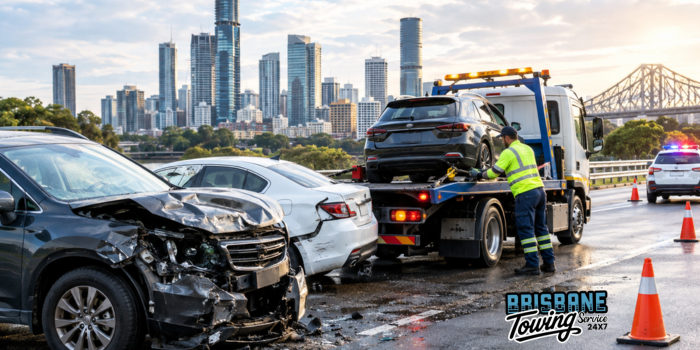
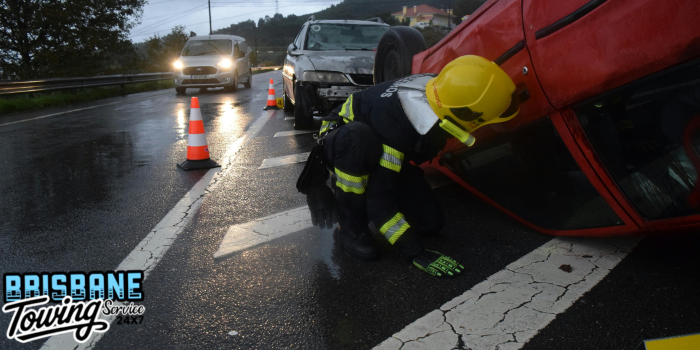
A blown tyre with no spare. An engine that has seized. A post-accident vehicle with structural damage. A battery that will not hold charge after a jump. Brake failure. Steering that has become unreliable. These are not situations for roadside improvisation — they are exactly why truck towing in Brisbane exists.
When a breakdown goes beyond what any toolkit can handle, the right call is the one that gets a professional operator with the right truck on the way quickly. Brisbane Towing Service operates 24 hours a day across Brisbane, Logan, Gold Coast, and Ipswich — upfront quote, honest arrival time, and the right equipment for the specific situation every time.
Emergency Tool Kit for Australian Drivers — Final Words
There you go!
We have covered everything Australian drivers — and Brisbane drivers specifically — should carry at all times. The right emergency toolkit does not prevent breakdowns. It changes how they end. A driver with the right tools handles the same situation faster, safer, and with significantly less stress than one who has nothing prepared.
Assemble the kit, check it every six months, and save a trusted towing provider's number before you need it.
If you find yourself in a situation beyond what any toolkit can handle, Brisbane Towing Service is ready to assist 24/7. Call us on 0466 890 373 for fast, professional towing across Brisbane and surrounding areas.
Also read: